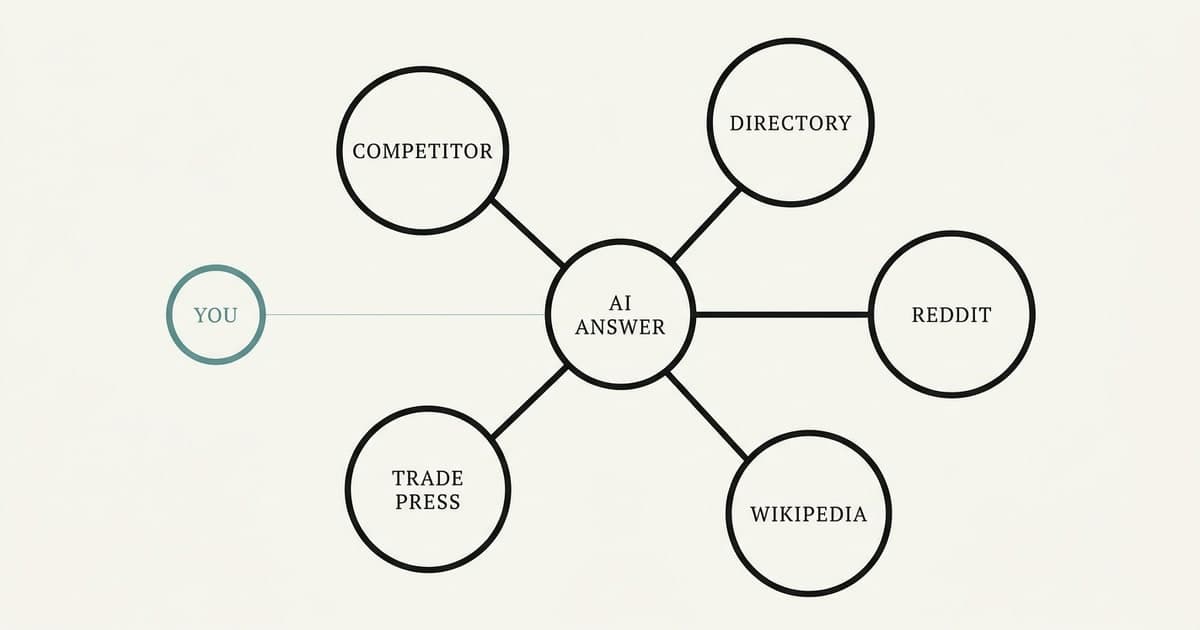
Run your brand through ChatGPT, Perplexity, or Google's AI Overviews and watch who gets named. Odds are it's everyone but you: a competitor, a directory, a Reddit thread, some trade publication. Your own site barely registers. That isn't a glitch. It's the normal shape of an AI citation graph, and once you've seen yours, the only question that matters is what to do about it.
Here's the hard part up front: almost none of that graph is yours, and you can't move most of it. Your own pages are a sliver. Wikipedia and Reddit you will never place. Your competitors' pages you cannot touch. So "get cited by AI" has to mean something narrower than it sounds: find the few sources you can actually move, and the few worth moving, and work those.
(This is the last post in a series, if you want the full picture of how I got here: how to measure whether you appear in AI answers, why citations drive that visibility, and the shape every citation graph takes. This post is the action layer.)
That leaves two questions, and they are the two that decide every move: how much a citation is worth, and whether you can influence it. Run your graph through them and the move list mostly writes itself.
You can't optimize a citation graph. You can only change what exists for the model to find.
What's actually in your citation graph?
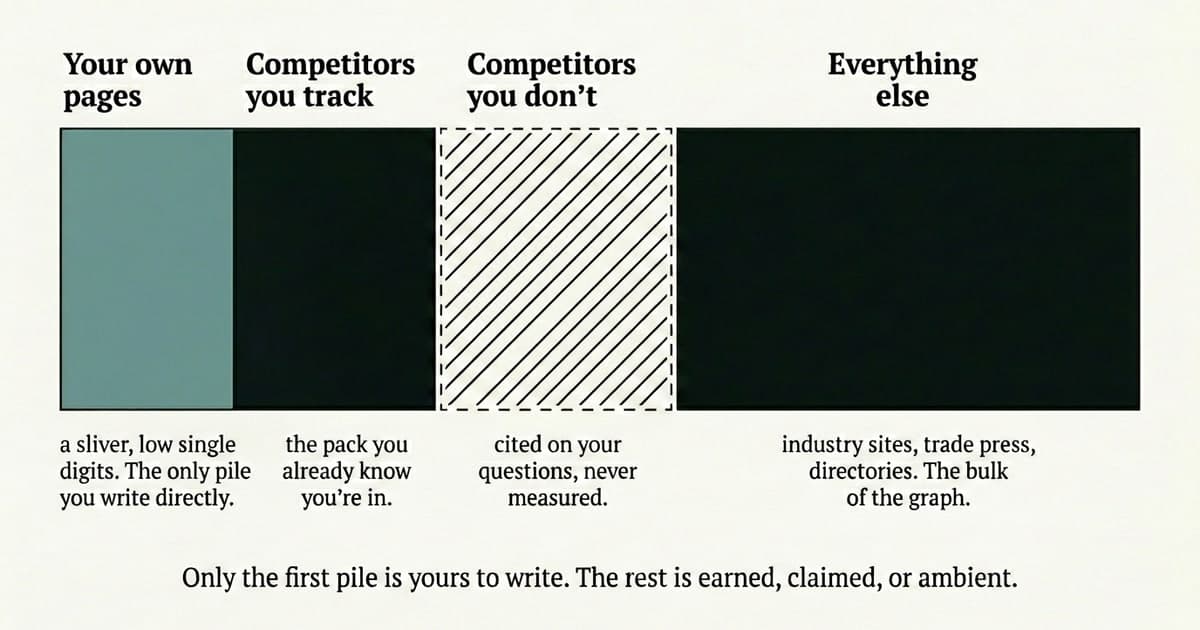
Before you act, sort the graph into four piles. Most tools hand you a flat list of cited domains; the list is unactionable until you split it.
Your own pages. The sources that are actually you. Usually a sliver, low single digits. The only pile you write directly.
Competitors you track. The rivals you already know about, showing up alongside you. This pile tells you where you sit in the set.
Competitors you don't. The sneaky one. Run the graph and you find agencies and operators getting cited on your exact questions that you were never measuring. Until you add them, your sense of the field is wrong.
Everything else. The wide third-party field: industry sites, trade press, directories, reference sources. The bulk of the graph, and the part that decides most of what the model says about your market.
Only the first pile is yours to write. The rest is earned, claimed, or simply ambient. Knowing which is which is the whole game.
So what do you actually do?
Four moves, one for each corner of the worth-versus-control grid from the last post, plus one that is measurement, not content.
Strengthen what you own, and start there. Your cited pages are the slots you fully control, so they are the fastest lever you have. Make each one the best answer to the question it gets cited on, and tighten the language on the pages that already get pulled. It is the floor, not the finish, but it is the move you can start today without waiting on anyone.
Earn your way onto the sources that cite your category. This is most of the upside, and it is real work you can run: PR, earned media, roundups, placement on the editorial and industry outlets the model already trusts. The judgment is where to aim. You pitch where citations already cluster for the questions you care about, not at random, and one well-placed piece on a trusted source keeps paying across many answers. Go after the warm ones first: the publications that already mention you. Turning an existing mention into a cited link, or sharpening how you are described, is the highest-return outreach there is, because the relationship is already built. Where you are genuinely notable, that reach extends to the high-authority sources like Wikipedia, through legitimate means, not by editing your own entry.
The fastest citation you'll earn is the mention you already have.
Claim the directories. The cheapest citations on the board. AI assistants pull from curated lists for "best X in [place]" questions, and most of those profiles are free to claim and complete. It buys presence, not position, because every competitor in the same directory carries the identical signal, so it is worth a weekend, not a quarter. One screen first: skip the AI-generated content-farm lists and the competitor-authored "best of" pages where the author is conveniently number one.
Let the genuinely unplaceable go. You are not getting into your competitors' pages, and the one-off long tail is unplaceable one source at a time. Account for it and put the effort where you have leverage. That is focus, not defeat.
Then the move that is not content at all:
Track the rivals you found, and map your zeros. Add the untracked competitors so your share-of-voice math reflects the real field. And write down the questions where you are cited zero times. That list is not a scoreboard of failure; it is your opportunity map.
Where do you start?
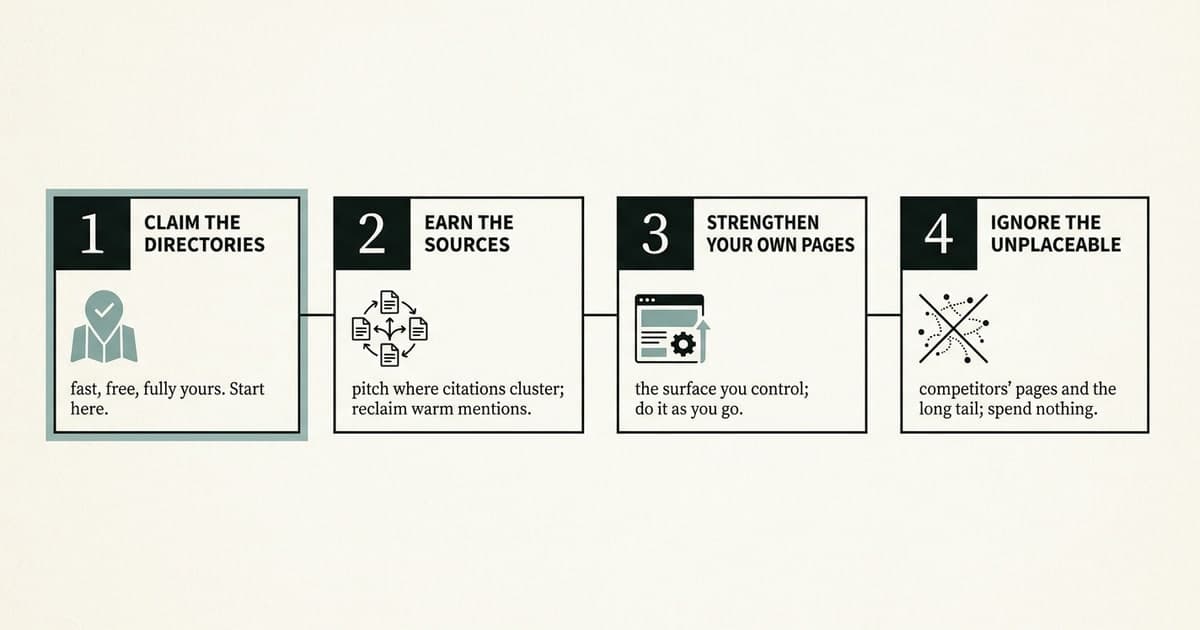
In order: claim the cheap directory wins first, because they are fast and you control them. Then pick one source to earn into, the single host where citations cluster on a question that matters to you. Strengthen your owned pages as you go. Ignore the ambient.
Picking the one earn target is where the zero-citation list earns its keep, and it depends on a distinction most tools miss. Your local, commercial questions ("who does X in [city]") tell you where you stand in your own market: defend those cheaply. Your broad, category questions ("what is X," "how do you do Y") tell you where the category gets cited and whether you are in it: that is where the opportunity lives, the citable surfaces you could earn into but do not hold yet.
The local questions are a scoreboard. The broad ones are a map. Read a blended number as "visibility" and you lose the map.
A tool runs a default prompt set and hands you one number. The work is designing the questions to match your market, then reading each part of the graph against the questions that produced it.
The honest limit
One caveat, so none of this tips into snake oil: you cannot tell a model which sources to trust, only change what it has to find. The levers are real but indirect, and anyone selling guaranteed AI citations is selling the one thing that cannot be sold. That is the same reason I don't promise ranks or traffic. What I can promise is the work: a graph you can actually read, and a short list of moves you can actually make.
FAQ
Four moves. Strengthen the pages you already own so each is the best answer to the question it gets cited on. Earn placement on the editorial and industry sources the model already cites for your category. Claim the directory profiles AI assistants pull from for "best X" questions. And leave the unplaceable sources (Wikipedia, competitors' pages, the long tail) alone. The order that works in practice: claim the cheap directory wins first, earn into one source where citations already cluster, and strengthen your own pages as you go.
That is the series. Measure whether you appear, understand why, read the shape of the graph, and then go work the parts you can move, which is more than it looks once you sort them: your own pages, the sources that cite your category, the mentions you already have, the directories worth claiming. The graph tells you two things at once: where you stand, and where to play.
If you want to see what your own citation graph looks like and what the short list of moves would be, book a free intro call. I'll run the harvest on your site and show you what I see.
No pitch, no pressure.

WRITTEN BY
SEO & Answer Engine Optimization Specialist
I'm an independent SEO and answer engine optimization specialist based in Morris County. I help small businesses rank in Google, and now in ChatGPT, Perplexity, and Google's AI overviews. No agency overhead. No junior account managers. Just focused, expert work.