
The previous post explained how I measure AI search visibility: leaderboard, mention rate, per-platform reads, 0% rows. That's the surface.
This is the substrate.
njseo's leaderboard position is downstream of a citation graph: 2,310 citations across 581 domains. That leaderboard runs on questions I chose, scored on my market, not a claim that I'm bigger than the national brands on it. The shape of that graph is the actual explanation for why my brand appears where it appears. Mention rate tells you whether; citation tracking tells you why.
The why is more useful than the whether.
In a list of links, ranking eleventh still exists; someone can scroll. In a synthesized answer, being uncited is being absent. There is no page two.
What is AI citation tracking?
AI citation tracking measures which third-party sources AI platforms cite when answering questions in your category. The output is a citation graph: a directed map from query to source to brand. The term comes from bibliometrics, where a citation graph maps which papers cite which. Point it at AI answers instead and it maps which sources a platform leans on when it responds to a question in your category, and where your brand sits in that web.
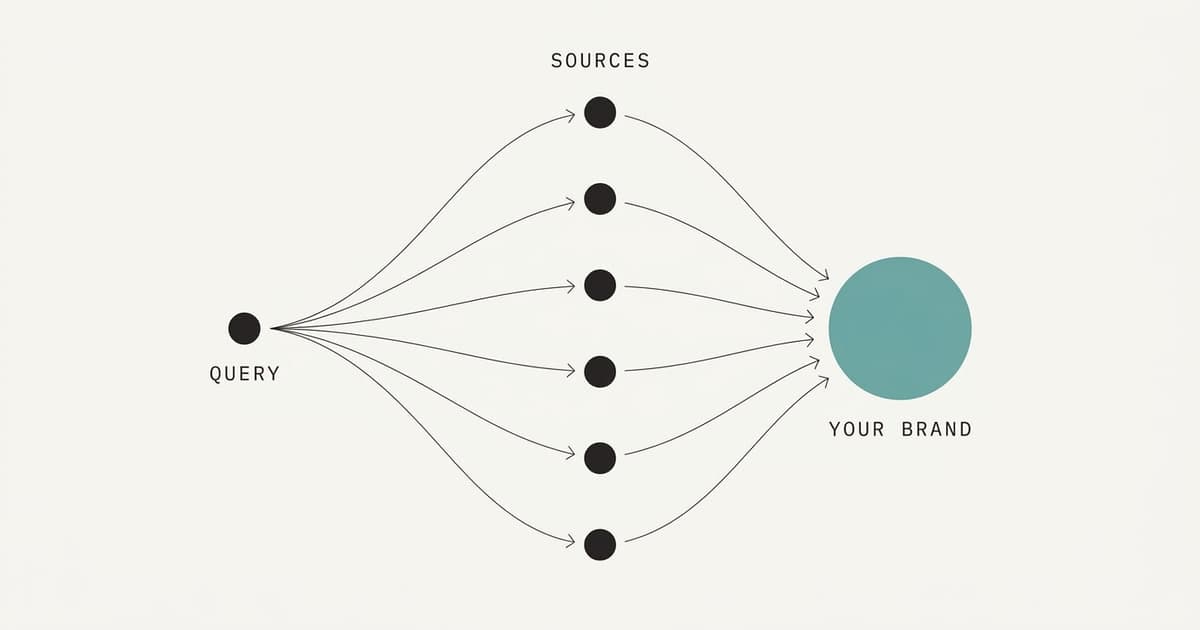
When ChatGPT answers "who does SEO in New Jersey," it pulls from a set of sources. AI citation tracking captures which sources, how often, and what proportion of those sources mention you alongside competitors.
Mention rate tells you whether you appear. Citation tracking tells you why. The graph is the substrate that produces every visibility leaderboard.
How the harvest works
I run the same defined prompt set against ChatGPT, Gemini, Perplexity, and Google AI Overviews on a fixed cadence, and every response lands in a database. How that pipeline is built is its own story; "How I Measure AI Search Visibility" covers the measurement layer, and a tracker build post still to come covers the plumbing. For citations, what matters is what each captured response carries with it.
Every answer an AI platform gives is built on sources, and the platforms I track expose them: a list of cited URLs attached to each response. The harvest reads each stored response and pulls those URLs out. One run of one prompt might cite eight sources; multiply that across a full prompt set, four platforms, and weeks of runs, and the raw count climbs into the thousands.
Raw URLs are noisy. The same source shows up as a bare domain, a deep article link, a tracking redirect, and a subdomain, all pointing at one publisher. So the harvest normalizes: strip the redirects, resolve each URL back to its source, and group every citation under the publisher it belongs to. That collapse, from thousands of URLs down to hundreds of sources, is what turns a pile of links into a graph.
The last step is sorting those sources into a handful of categories: peer agencies, directories, editorial outlets, tool vendors, platform and community sources, your own pages, and the long tail of everything cited once or twice. Each category means something different, which is the next two sections. What to do with each one is a later post in this series. Categorized and counted, the graph is finally readable.
But what it shows you was decided upstream, by which questions you asked. I run two kinds. Local commercial questions ("who does SEO in New Jersey") measure where I stand in my own market. Broad discipline questions ("what is generative engine optimization") measure where the category gets cited and whether I'm in it.
The first is a scoreboard. The second is a map.
Ask only the narrow ones and the graph comes back clean, flattering, and useless: you learn your rank among five rivals and stay blind to every surface you could earn into. The breadth is the point.
Reading the citation graph
Across the questions I track, the platforms make 2,310 citations across 581 domains. Most aren't me, and that's the point: the graph maps every source the model trusts for my category, not just my own mentions. Nearly half those domains, 282 of 581, are cited exactly once: a long tail, not a short list of gatekeepers.
Even the 14 most-cited domains together are just 22% of all citations. The rest spreads across hundreds of sources the model reaches for once or twice.
The shape tells you one thing loudly: no small set of sources controls my visibility. A top-heavy graph would mean the model leans on a few gatekeepers, and winning those would win the category. Mine is the opposite, tail-heavy. What kinds of sources sit at the head of it, and what each kind means, is the next section.
What each source category implies
Every citation is the model making an argument, sometimes about your brand, sometimes about your whole category. The kind of source tells you which.
Peer-agency pages. When the sources citing you are other agencies working the same queries, the model is grouping you. The argument is "this brand is one of these brands." It is real inclusion, and it is the most crowded read: you appear because you belong to a set, not because you stand apart from it. These fill njseo's local graph, which is what a tight regional market produces.
Editorial and institutional. When citations come from outlets like the Digital Marketing Institute or legal-trade publishers, the argument changes to "this brand is what the authority on the topic points to." It is the read most brands want and the hardest to earn, and it compounds: models return to editorial sources across many queries, so one well-placed citation keeps paying.
Directory aggregators. When the citation is a directory, the argument is thin: "this brand is in the database." The model found you in a list. That buys presence and almost no trust, because every competitor in the same directory carries the identical signal. Directories are a floor, not a position.
Tool-vendor content. The surprise in my graph: at 12% it's tied with the long tail as the largest category after peer agencies, not a footnote. When the model answers questions in my category, it leans on the SEO and AEO/GEO tool ecosystem's explainers (Semrush, Profound, Clio, Jasper, and a wave of newer AI-search tools) as the canonical account of what this category is. The argument is associative: the model treats tool-vendor write-ups as where the category gets defined. That makes it a real surface, not a curiosity, and one I'm mostly not on yet.
Platform and UGC. YouTube, Reddit, Wikipedia, LinkedIn. These are the sources the model trusts across almost every topic, not just mine: the universal trust core that surfaces in almost any citation graph. The argument is contextual: "here is where the open web is talking." You rarely place these on purpose, but their weight high in the graph is the reminder that AI answers lean on community and reference sources, not only commercial pages.
Your own site. When the model cites your pages back to you, the argument is direct: "this brand's own content is the source worth pulling." It is the strongest signal you can build on purpose, and the rarest, because your page has to beat every third-party alternative for that query. njseo holds a handful of these slots, not many.
The long tail. Past the named categories, most domains are cited just once or twice: independent practitioners, niche blogs, adjacent-industry pages, a couple hundred of them. The argument is reach over depth: "this brand turns up across a wide citation surface." That is the diversity read, and it is more durable than it looks: a wide tail means the model is not leaning on a few gatekeepers to find you.
Every citation tracker on the market captures this same data. They show you the table and call it a dashboard.
The capture is commoditized; you could rebuild it in a weekend. What no tool does is read the shape and tell you what it means for you specifically.
Here is the read a dashboard won't give you. Because I ask both kinds of question, my graph is really two graphs. On the local questions, my own pages lead, but barely: right behind them sits a directory that lists every NJ agency, then a dense pack of the competitors I share the market with. I lead the pack; I have not broken from it.
On the broad questions, the picture inverts. My own site drops out of the top tier entirely, and the sources are national editorial and tools: Search Engine Land, the Digital Marketing Institute, Semrush. There I am not a top source at all.
One graph shows my position. The other shows my opportunity: the surfaces I would have to earn into and don't yet hold.
One brand carries several of these arguments at once, on different queries. Reading the graph by category is how you stop asking "how visible am I" and start asking "what is the model actually saying about me, and is that the argument I want it making."
How distributions vary across verticals
The shape of njseo's graph reflects its niche: local services + small competitive set + legal-adjacent vertical fingerprint. A B2B SaaS site would skew editorial. A consumer brand would skew review-site and social. A national service brand would skew directory.
How citation graph shapes vary across verticals, and what universal patterns hold across all of them, is the next post in this series: Anatomy of an AI Citation Graph.
FAQ
An AI citation is a source an AI platform pulls from and links to when it answers a question in your category. When ChatGPT or Perplexity names a brand and shows where the claim came from, each linked source is a citation. Collected across many queries, your citations form a citation graph: a directed map from query to source to brand. Citations are the trust signals a model leans on, which is why which sources cite you decides whether you appear at all.
Mention rate is the surface. The citation graph is the substrate. Together they tell you whether you're appearing in AI answers and why.
The next post in this series, Anatomy of an AI Citation Graph, analyzes citation graph shapes across many sites and verticals. The post after that covers what to do with the patterns you find.
If your AI search citation graph is a question mark, book a free intro call. I'll show you what I see when I run the harvest on your site, and whether the engagement makes sense.
No pitch, no pressure.

WRITTEN BY
SEO & Answer Engine Optimization Specialist
I'm an independent SEO and answer engine optimization specialist based in Morris County. I help small businesses rank in Google, and now in ChatGPT, Perplexity, and Google's AI overviews. No agency overhead. No junior account managers. Just focused, expert work.