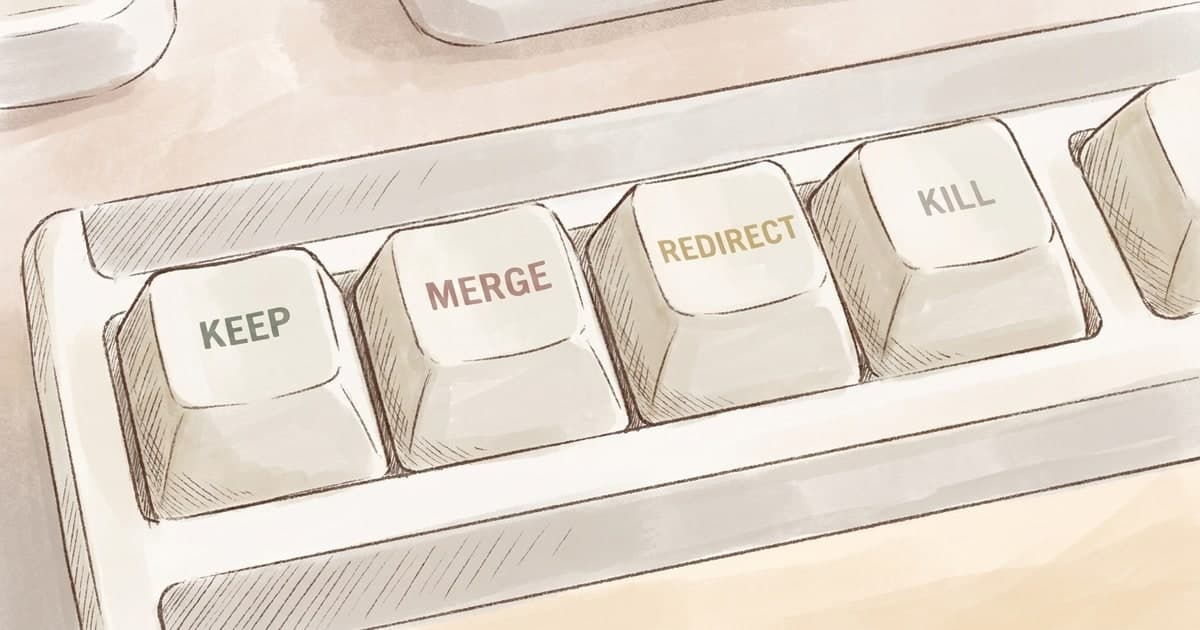
I had 60 pages. I kept 5. Small library, no flex.
The framework works the same on a 600-page site or a 6,000-page one. I've run it on client audits past 30,000 pages. Volume is not the question.
What is the question? Which pages earn their place.
Most pruning advice argues that you should cut. The hard part is what to keep, what to merge, and what to let go.
This is the content pruning framework I used on my own site this April. Same rules apply at any scale.
Why most pruning advice misses the actual decision
Search "should I delete old content" and you get a hundred posts arguing yes. Crawl budget. Topical authority.
Content debt. The macro case is settled.
The macro case is not the work.
The work is sitting at a spreadsheet of URLs deciding which slice of your library still earns its place. That's the part nobody writes. So here.
The three questions I ask about every page
Three questions. Every page. No skipping.
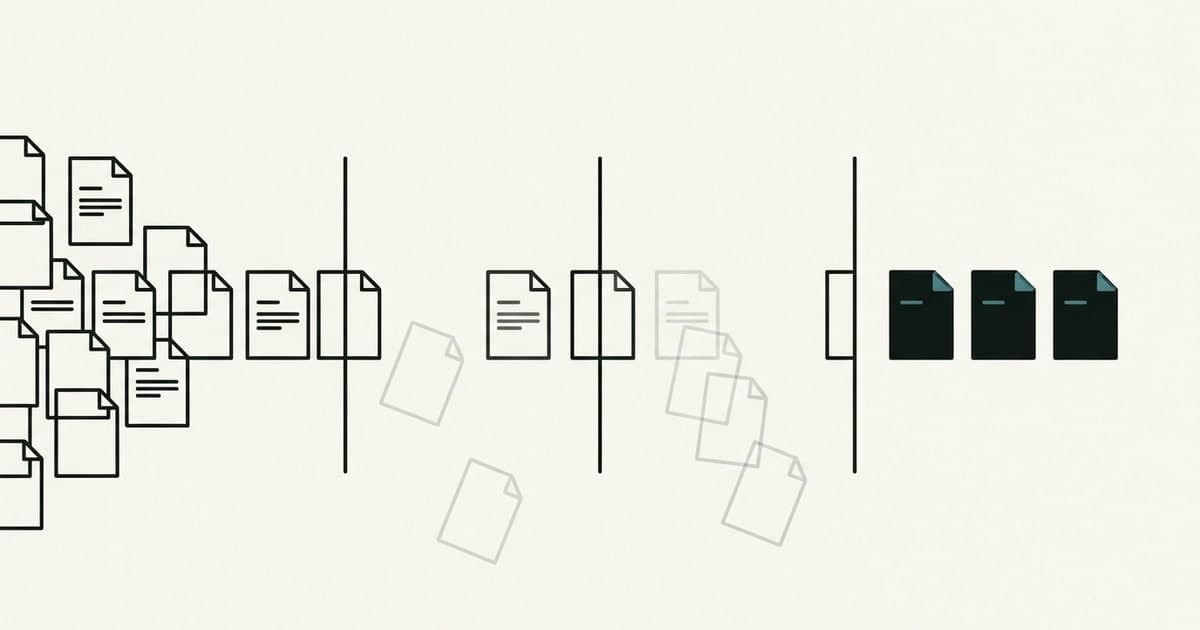
A page survives if it answers yes to all three. A single no makes it a candidate for merge, redirect, or kill.
Does it earn its keep?
Two tools. Two signals.
Open GA4. Pull the last 6 months. Sessions to the page, by source.
That captures visits from any surface: organic, direct, email, paid, redirect traffic carrying through.
Open Google Search Console. Pull impressions, queries, and AI Overview appearances for the same window. That captures search-surface visibility, even when nothing clicks through.
AI Overview citations show up here as impressions. The page is being used to satisfy a query, just without the click.
A page is the kill candidate when it scores zero across both: no GA4 sessions, no GSC impressions.
Nobody is finding it. Nothing is satisfying a query through it. The page is not doing work for anyone.
A page is a Keep when either signal is real. GA4 traffic without GSC impressions means email, direct, or referral is feeding it.
GSC impressions without clicks often mean answer-engine work: AI Overviews, featured snippets, and other surfaces where queries get satisfied without a SERP click. They can also mean the page is ranking but the snippet isn't earning the click. Worth a look at the query in SERP.
So this question is a signal, not a sentence. Pages with conversion roles, redirect-fed traffic, or AI Overview presence keep their seat even when neither tool surfaces them.
Does it serve an intent this site actually answers?
Topical fit. The harder question. This is where most audits fail.
Old sites accumulate content from old strategies. A 2013 favicon post does not belong on a 2026 SEO consultancy site, even if it gets traffic. The traffic is not your audience.
Ask: would this page exist if I were starting the site today? If no, the page is a tax on the site's coherence. Topical authority compounds for the topics you commit to and dilutes across topics you don't.
Does it carry equity worth preserving?
Backlinks · internal links · citations · branded mentions.
Equity travels with a 301. So a page can lose every other test and still earn a redirect to a better-positioned survivor.
The page itself dies. The link equity feeds something stronger.
A page with no inbound equity, no fit, and no clicks is a 404 candidate. Not every URL deserves a redirect. Some are simply done.
What the four outcomes look like
Four buckets. Every page lands in one.
Keep
/attorney-seo/ survived intact. Same URL on the new site.
The page itself was rewritten from scratch, but its identity is preserved. The slug is the slug.
A keep is a page that fills a unique role on the site. Different URL, different intent, different conversion path. If it didn't exist, the site would have a hole.
Merge
/morristown-seo-company/ and /nj-seo-company/ both fed the same intent: someone in New Jersey looking for an SEO firm. Two pages competing for the same query is two pages splitting the equity. Both got merged into /local-seo/.
One stronger page. Same intent. Half the maintenance.
A merge is the right call when two or more pages have unique substance pointing at the same job. The substance combines into one survivor. The original URLs 301 to the merged page.
Redirect without merging
/services/ got redirected to /. Nothing got merged. The old services hub had link equity worth preserving but no substance worth migrating: the new homepage handles that job directly now, with a different shape.
The redirect captures the equity. The content does not survive.
Use this when a page has equity to preserve and substance you can let go.
Kill (let it 404)
Roughly 35 posts from 2012 and 2013 are 404ing on launch day. No equity, no traffic, no topical fit.
No reason for them to exist.
Letting a URL 404 is not a mistake. It is a clean signal to Google: this page is gone. If the page does not deserve a redirect (no equity, no relevance), a 404 is the honest answer.
How aggressive should you be?
The question every reader actually wants answered.
Default aggressive. The cost of a thin page is real. The cost of cutting one wrong is recoverable.
If "default aggressive" feels reckless, start pruning. Take the obvious cuts first: pages with no traffic, no impressions, no equity, no topical fit. Those decisions are easy. The harder calls get clearer once the obvious ones are gone.
Two edge cases worth thinking through.
A page that ranks for nothing but converts
Keep it. GSC won't show its value. The conversion path matters more than the search visibility. This is rare on a content-heavy site, but real.
A page that has 80 visits a month from a query that's not your buyer
Cut it. Visits without conversion are not assets. They're noise that fragments the site's topical signal and dilutes the signal for the queries you actually want.
If you're unsure on a borderline page, default to merge over keep, and redirect over kill. Reversible decisions are cheaper than the wrong commitment.
Why volume isn't the question
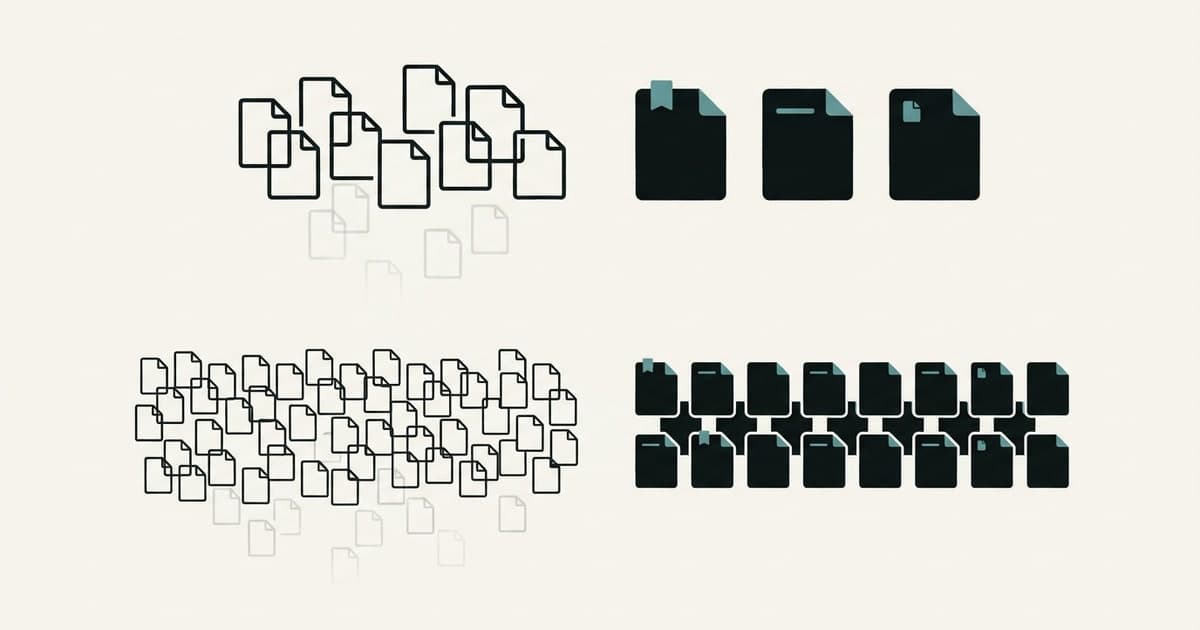
A 60-page consultancy and a 600-page SaaS site use the same framework. The cut depths are different. The decisions are not.
FAQ
No. Pruning is the decision. Deleting is one of four moves.
The other three are keep, merge, and redirect. A 404 is the right call for a page with no traffic, no equity, and no topical fit. For pages with equity, a 301 to a stronger survivor preserves the link weight. For pages with unique substance, a merge into a related survivor is cleaner than two competing URLs.
Pruning is what you're doing. Killing is one of the outcomes.
My site is a portfolio piece. Yours is a conversion tool.
That gap doesn't change the rules. It changes the cut depth.
My site is back online with 5 pages. Whether yours lands at 50 or 500, the job stays the same.
Run the three questions on every URL. Keep, merge, redirect, or kill. Then ship the site you actually want.
Part 4 of the series is up: what I shipped on the schema layer of the rebuild. What counts as structured-data basics in 2026, what I layered on top, and three practitioner calls I caught getting wrong.
If your content library has been quietly piling up, book a free intro call. I'll tell you what I see and whether the engagement makes sense.
No pitch, no pressure.

WRITTEN BY
SEO & Answer Engine Optimization Specialist
I'm an independent SEO and answer engine optimization specialist based in Morris County. I help small businesses rank in Google, and now in ChatGPT, Perplexity, and Google's AI overviews. No agency overhead. No junior account managers. Just focused, expert work.