I run an SEO firm. I rebuilt my site on Next.js. Most of my clients are on WordPress and that's the right call for them.
If you're a business owner staring at a proposal to rebuild your site on a modern JavaScript stack, this post is for you. Not the developer side. The decision side.
Here's the honest version, from someone who just did it.
§ 01 · Why I moved from WordPress to Next.js
The site I run is part of how I sell. An SEO firm with a slow, dated WordPress install is a bad signal. I wrote about where it stood when I started: 205 homepage impressions, zero clicks, page-three for my own targets. So when I started this rebuild, I told myself I needed a showcase: fast page loads, clean technical structure, the kind of work I'd want a prospect to inspect.
That's a real reason. It's also a flattering one.
The less flattering reason is what a buddy at work always asks me when I bring up a side project: "Why rebuild it if it exists?" I never have a good answer. I overengineer things. I rebuild systems that already work because I want to know how they work. That's a flaw I haven't fixed in twenty years.
Both reasons are true. Neither one applies to most businesses.
I needed a showcase. You probably need a phone to ring.
§ 02 · What WordPress does that Next.js doesn't out of the box
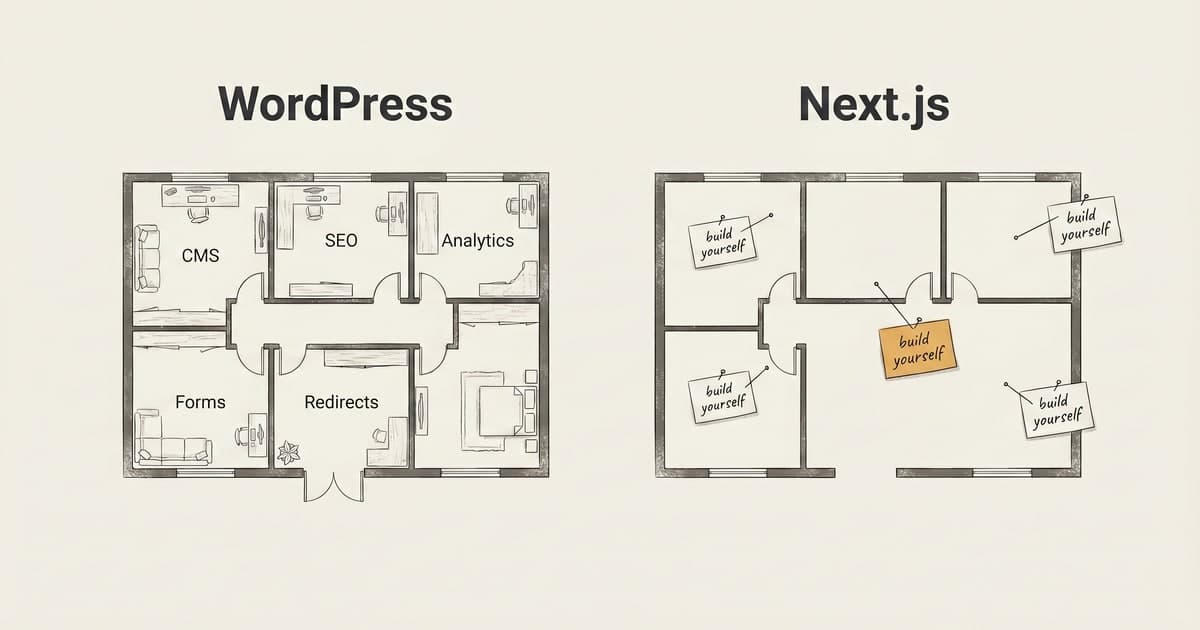
The most surprising part of this rebuild was the list of things I had to write from scratch that I didn't realize WordPress was doing for me. None of them are interesting problems. All of them are real work.
The CMS itself. WordPress is a CMS. That's the whole thing. I ended up writing my own: markdown files with YAML frontmatter, a custom content loader, a schema for every field, a build step that turns those files into static pages. It works. It also has no visual editor, no draft preview without spinning up a local dev server, and no revision history beyond git blame. Editing a post means editing a .md file and pushing a commit. That is not a workflow I would hand to a non-developer.
SEO infrastructure. Yoast or Rank Math give you title and meta description fields, canonical URLs, an XML sitemap that updates on publish, Open Graph tags, and schema markup with UI toggles. I built all of that by hand. Schema helpers for LocalBusiness, WebSite, Service, BlogPosting, BreadcrumbList, FAQPage. Canonical URL logic with a trailing-slash policy enforced in config. A sitemap.js file that requires a code change every time I add a page. None of it is hard. Together, it took weeks.
Analytics. On WordPress, you install a GTM plugin and pageviews fire. On Next.js, the App Router uses client-side navigation. The browser never actually changes pages, so GTM's normal "All Pages" trigger never fires. I had to write a custom component that watches the route and pushes page_view events into the dataLayer by hand, then wire up a matching trigger in GTM. I diagnosed it by trial and error, because the broken trigger was failing silently.
The contact form. WordPress: install WPForms, configure, done. Email delivery, spam filtering, storage. On Next.js, I wrote a server-side API route, integrated the Resend email API, added rate limiting, added input sanitization. Then I had to debug a build-time crash caused by initializing the Resend client outside the request handler.
Redirects. I had sixty old WordPress URLs that needed 301s to preserve whatever link equity I had left. WordPress has the Redirection plugin: paste old URL, paste new URL, save. On Next.js, I wrote the entire redirect map in next.config.js by hand. Every new redirect is a code change and a deployment.
Each one of these is a problem WordPress already solved. Twenty years ago. For everyone.
§ 03 · Should you switch from WordPress to Next.js?
If you have a developer in-house who likes maintaining things, and your site needs custom frontend behavior that themes resist, Next.js is a serious option. If you're delivering content to more than one frontend, or your site is becoming a product instead of a website, the case gets stronger.
If your site exists to convert phone calls or form fills, stay on WordPress. If you don't have a developer, stay on WordPress. If you'd rather pay someone to make your site rank than learn how next.config.js works, stay on WordPress.
WordPress is not the cool answer. It is the right answer for most small businesses, and "cool" is not what your site is for.
§ 04 · Is Next.js better than WordPress for SEO?
Going through this rebuild changed how I think about client engagements. Most SEO problems do not require a new website. They require attention to the website you already have.
Slow site? Move to better managed hosting. Cut the plugin sprawl. Switch to the block editor before adding another page builder. Those changes are cheap and they fix the actual issue.
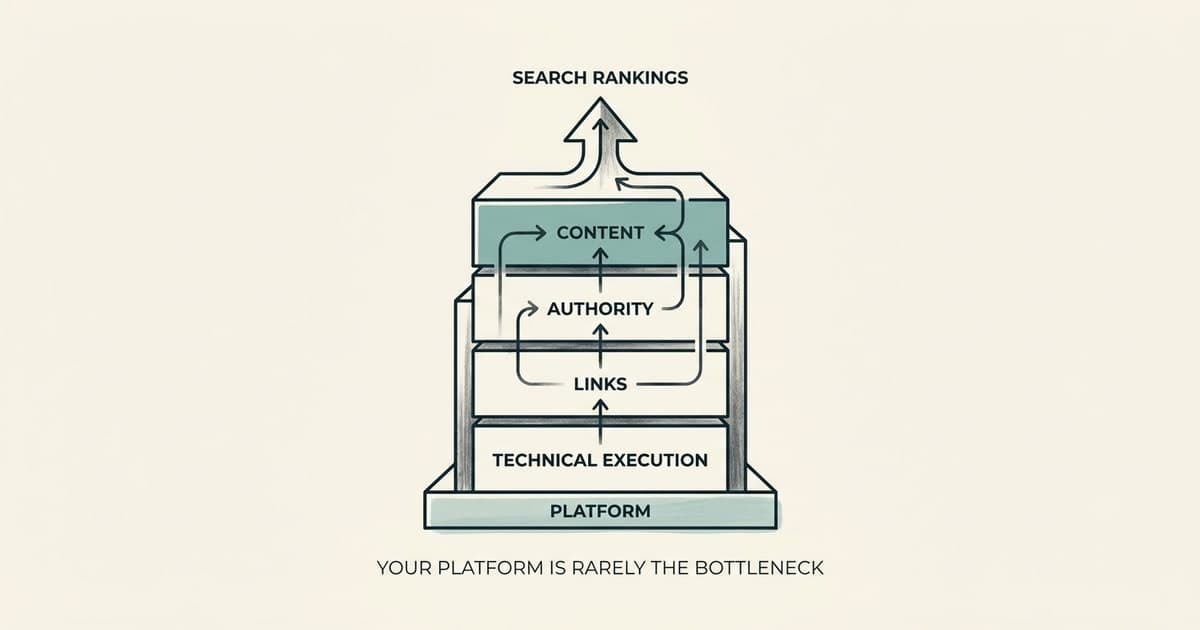
Bad rankings? That's almost never a platform problem. It's an authority problem, a content problem, or a technical-SEO-execution problem. Rebuilding the site from scratch will not fix any of those. Google's own site-move guidance is built around preserving the signals that already rank you: URLs, redirects, content. The platform underneath those signals is not what's doing the work. I've watched plenty of businesses spend twenty thousand dollars on a redesign and then call me confused about why their traffic didn't move.
Your platform is rarely the bottleneck. The work on top of it is.
FAQ
Only if you skip the migration basics. The signals that rank you live in your URLs, redirects, and content, not the platform itself. If you preserve those (one-to-one 301s, identical content at the new URLs, an updated sitemap), the platform change should be neutral. The risk isn't the framework. It's a rushed migration that breaks redirects.
If you're tempted to do what I did, talk to me first. I can probably save you the regret.
Part 3 of the series is up: how I decided what to keep, merge, redirect, or kill. The framework I used to cut my own site to five pages.
Book a free intro call. I'll look at your current site and tell you whether a rebuild would actually help. If it wouldn't, I'll say so.
No pitch, no pressure.

WRITTEN BY
SEO & Answer Engine Optimization Specialist
I'm an independent SEO and answer engine optimization specialist based in Morris County. I help small businesses rank in Google, and now in ChatGPT, Perplexity, and Google's AI overviews. No agency overhead. No junior account managers. Just focused, expert work.