
Bad links are links that violate Google's Spam Policies for link spam. They are built to manipulate PageRank rather than earned through content or reputation. The category includes purchased links, link exchanges, private blog networks (PBNs), sitewide footer links with keyword-stuffed anchors, and comment spam.
The definition has not changed much since 2012. What has changed is how Google enforces it.
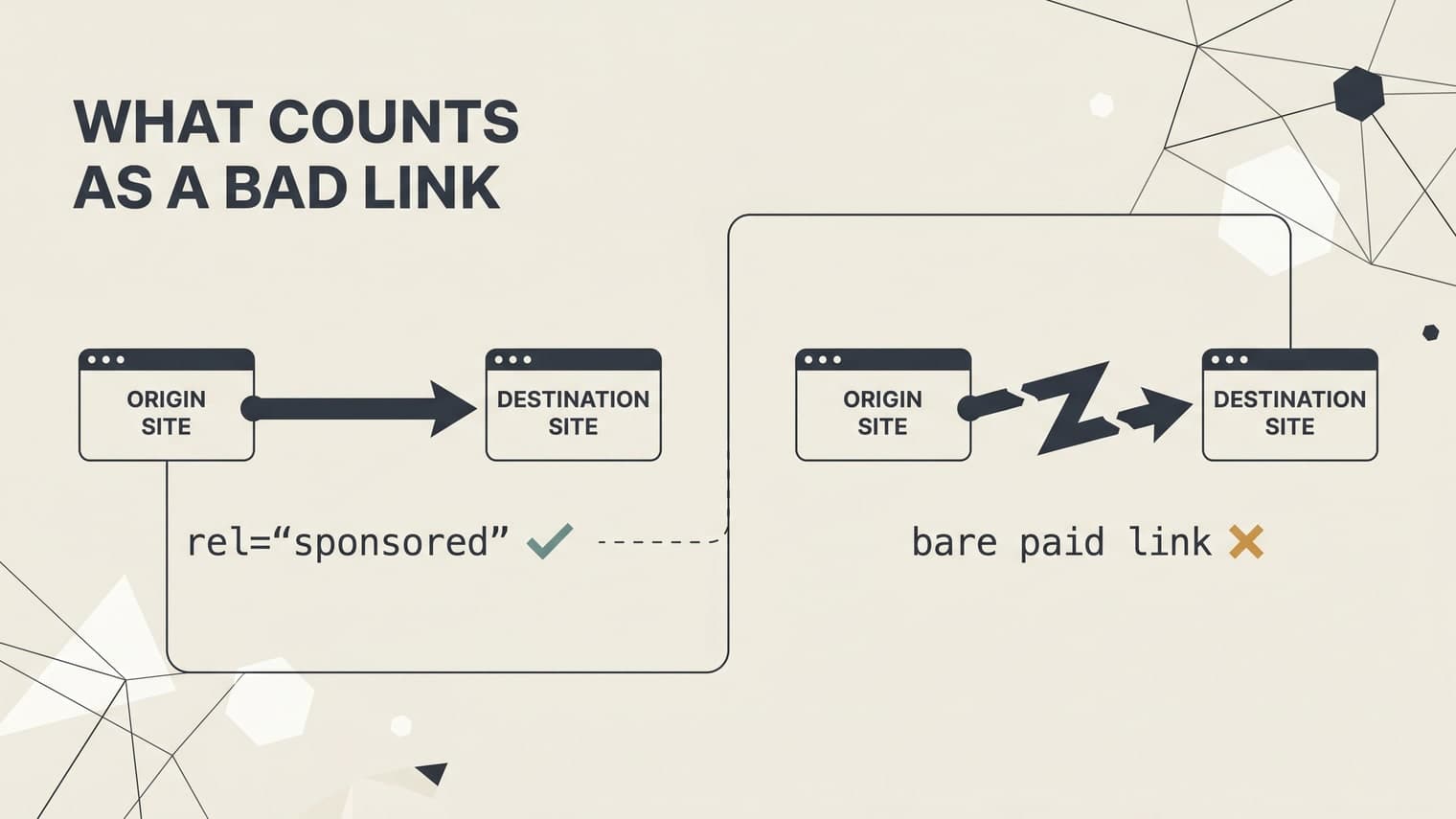
What counts as a bad link?
Google's Spam Policies name these specific practices:
- Buying or selling links that pass PageRank, without a
rel="sponsored"orrel="nofollow"tag - Link exchanges: "link to me and I'll link to you" arrangements
- Private blog networks (PBNs): sites built solely to pass links to a target domain
- Sitewide or footer links with keyword-rich exact-match anchors
- Comment spam on blogs and forums
- Bulk submissions to low-quality article directories or bookmarking sites
- AI-generated content published at scale to embed paid backlinks (added December 2025)
One clarification that trips people up: rel="nofollow", rel="sponsored", and rel="ugc" do not make a link bad. They describe the relationship. Google explicitly recommends these attributes for paid and user-generated situations and treats them as hints, not as evidence of wrongdoing. A sponsored link with proper tagging is compliant. A sponsored link without it is a policy violation. The distinction is the tag, not the payment.
If you hired an SEO firm before 2015 and never audited what they built, your backlink profile likely has some of these. The Penguin updates from 2012 to 2016 flagged a lot of this work. Not every site cleaned up in time.
How does Google handle bad links in 2026?
The default response is to ignore the link, not to penalize your site.
Penguin became part of Google's core algorithm in 2016 and has run continuously since. That ended the era of Penguin-as-event. Your backlink profile is evaluated in real time, not during periodic named updates.
SpamBrain, Google's AI-based spam detection system, has handled most link spam algorithmically since 2022. The December 2022 expansion was the first time SpamBrain was specifically deployed for link manipulation. According to Google's Webspam Report, it caught 50 times more link spam sites than the July 2021 link spam update. Google's March 2024 spam policies update further expanded enforcement to scaled content abuse and expired domain abuse. The March 2026 spam update extended SpamBrain's network-level analysis and completed its rollout in under 24 hours.
What that means for your site: most bad links pointing to you are already being devalued. Google identifies the link as spam, strips the ranking credit, and moves on. No alert in Search Console. No ranking drop from that link. It is treated as if it does not exist.
Manual actions still happen. They apply to sites actively running large-scale, deliberate link schemes: operating a PBN, selling links, or buying links in coordinated anchor campaigns. If you have a manual action, it appears in Google Search Console under Security and Manual Actions. Most sites do not have one.
Check there first, before doing anything else about your backlink profile.
What do good links look like?
The simplest test: would you still want this link if Google did not exist? If the answer is yes, because it sends the right readers, strengthens credibility, or reflects a real relationship, it is a good link. If the only reason to care about it is ranking credit, that is worth examining.
Good links share a few consistent traits:
- The linking site is topically related to yours
- The linking page has real traffic and its own authority
- The anchor text is varied: brand name, bare URL, partial keyword, generic phrase
- The link is editorial: the site owner chose to include it
Here is how common scenarios break down:
| Scenario | Verdict | Why |
|---|---|---|
| Industry publication cites your original research in body copy | Good | Editorial, topical, user-helpful |
| Trade association member listing on a real association page | Good | Legitimate relationship, not created solely for ranking |
Sponsorship page with rel="sponsored" disclosed |
Compliant | Correctly classified; not masquerading as editorial |
Paid guest post without rel="sponsored" or nofollow |
Bad | Unqualified paid placement, policy violation |
| Forum comment with exact-match commercial anchor | Bad | Google explicitly names this as link spam |
| Sitewide footer link with keyword anchor across many domains | Bad | Google explicitly names footer/template links as link spam |
| Link from hacked page or injected content | Bad | Deceptive and policy-violating |
| Low-quality directory on a bulk-submission site | Bad | Google explicitly calls these out |
| Nofollow link from a relevant page that sends real traffic | Fine | Little ranking credit, but legitimate and safe |
An attorney's profile on Avvo or a state bar directory listing is a good link. A directory that takes every $99 listing regardless of quality is not.
For New Jersey businesses, local links carry real weight: mentions in local news, chamber of commerce listings, industry associations, university press pages, local business directories with editorial standards. These take more effort than a directory submission. That is exactly why they matter more to Google.
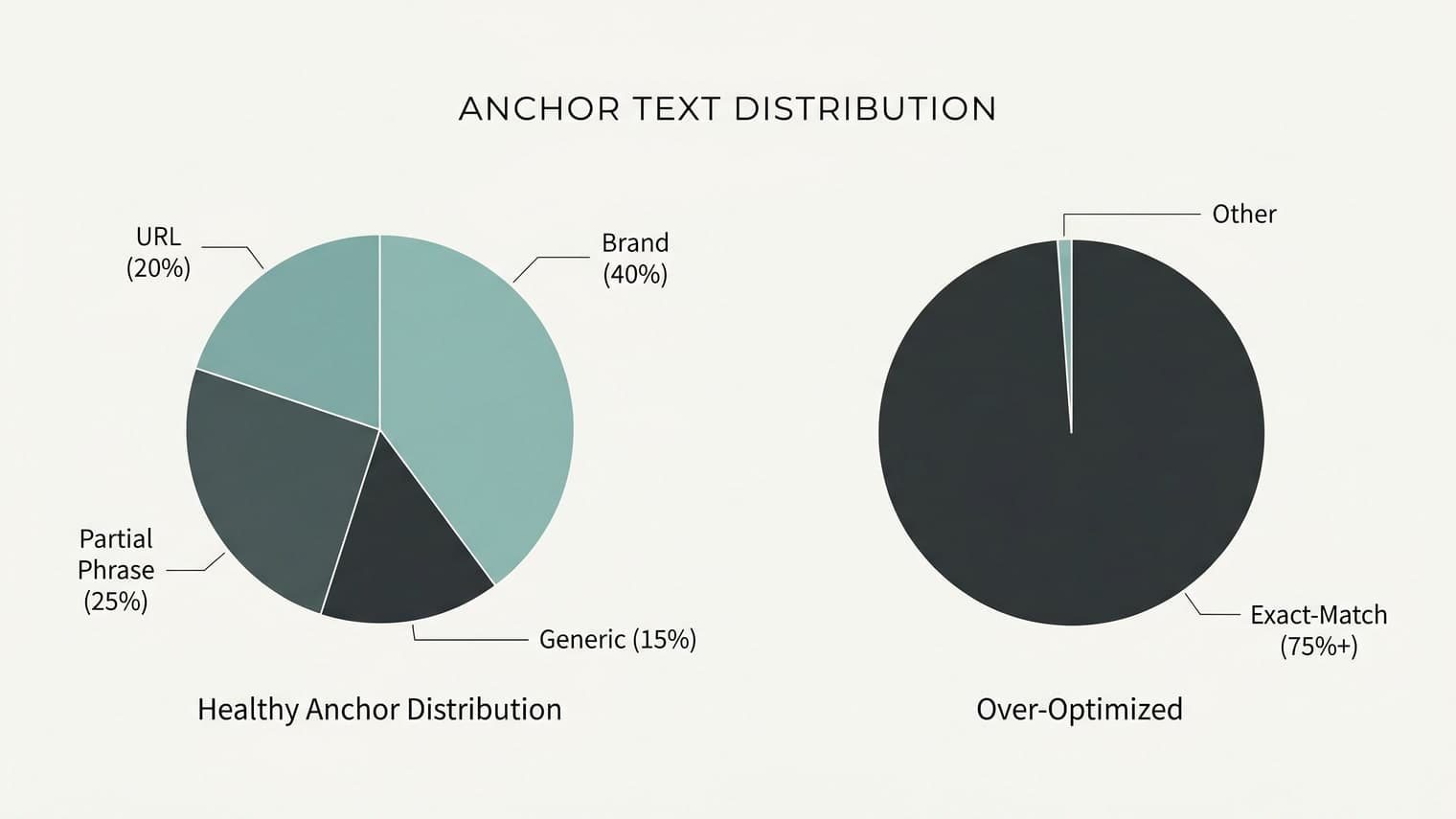
Why does anchor text matter for backlinks?
One thing that aged poorly from early link-building practice: exact-match anchor text at scale.
If 70 to 80% of the links pointing to your site use the same keyword phrase as the anchor, that is a detectable pattern. Natural link profiles show anchor variety: your business name, your domain, partial phrases, "click here," "this article," "learn more," and sometimes the bare URL with no anchor at all.
Exact-match anchor campaigns were standard before 2012. Sites that never addressed them are still carrying that risk. An anchor distribution report in Ahrefs or SEMrush takes about 20 minutes and shows the breakdown immediately.
What should you do if you have bad links?
Start in Google Search Console. Check Security and Manual Actions. If it is empty, you do not have an active penalty. Your immediate risk is low, and Google is handling most inbound link spam algorithmically.
If you want the full picture, run a backlink audit. Pull your referring domains, review the anchor distribution, and flag anything that looks like a PBN or link farm. Signals to watch for: thin content on the referring site, no real traffic, domain ages that cluster together, identical site templates across dozens of domains.
When reviewing your backlink data, cluster by pattern rather than reviewing links one by one. Typical clusters: same keyword anchor across many domains, same IP or GA/AdSense footprint, sitewide footer links, forum and profile comment spam, thin directories, and bursts of links acquired in a narrow window. Pattern-level triage is much faster than per-URL review and is how Google itself describes the problem in its spam policy examples.
If you find toxic links, reaching out to the webmaster to request removal is the cleanest option. Response rates are low. Accept that upfront. For the worst offenders (hacked sites, link injection, obvious PBN links) it is worth the attempt.
For anything you cannot remove, Google's Disavow Tool is available in Search Console. You submit a file listing domains or URLs you want Google to ignore.
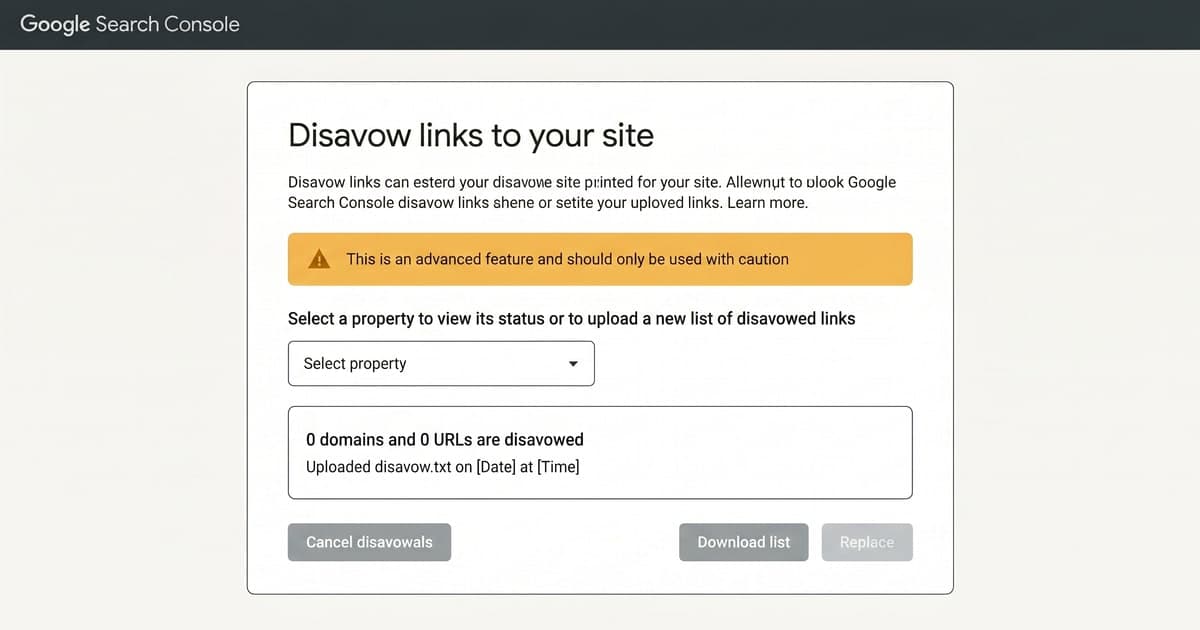
Should you use the disavow tool in 2026?
Google's position on disavowing has shifted significantly over the last two years. In February 2024, John Mueller said: "The concept of toxic links is made up by SEO tools so that you pay them regularly." In May 2024, he suggested Google would eventually remove the tool entirely.
Bing went further. It removed its disavow feature entirely in October 2023, stating that its systems can better distinguish natural from unnatural links and ignore or discount the latter algorithmically. No disavow file, no submission process. Google is heading in the same direction.
There is also a real risk from over-disavowing. Google explicitly warns that the disavow tool can hurt your search performance if used incorrectly. Removing legitimate editorial signals by mistake leaves you worse off than before. The standard for disavowing should be "clearly manipulative and policy-violating," not "low authority" or "looks sketchy." SEO tools that generate "toxic link" scores are making up a threshold Google does not publish.
The disavow tool exists for one specific situation: sites with a manual action that need to demonstrate to Google they have identified and addressed manipulative links as part of a reconsideration request. For passive accumulation of spammy inbound links you did not build, submitting a disavow file is unlikely to change anything. Google is already ignoring those links.
If you have a manual action, disavowing is part of the recovery path. If you do not, spend the time building better links instead.
Five fair questions
Rarely, and not automatically. Google's default response to bad inbound links is to ignore them, not penalize your site. SpamBrain strips ranking credit from links it identifies as manipulative. Manual actions still exist, but they apply to sites actively building link schemes, not sites passively receiving spam links. Check Google Search Console under Security and Manual Actions. If nothing is there, you do not have an active penalty.
I audit backlink profiles as part of NJ SEO engagements. If your Search Console has a manual action or your anchor distribution looks off, that's the conversation to have before anything else.
No pitch, no pressure.

WRITTEN BY
SEO & Answer Engine Optimization Specialist
I'm an independent SEO and answer engine optimization specialist based in Morris County. I help small businesses rank in Google, and now in ChatGPT, Perplexity, and Google's AI overviews. No agency overhead. No junior account managers. Just focused, expert work.